General of the Army
Dwight D. Eisenhower |
|---|
 |
|
| 34th President of the United States |
|---|
In office
January 20, 1953 – January 20, 1961 |
| Vice President | Richard Nixon |
|---|
| Preceded by | Harry S. Truman |
|---|
| Succeeded by | John F. Kennedy |
|---|
| 1st Supreme Allied Commander Europe |
|---|
In office
April 2, 1951 – May 30, 1952 |
| President | Harry S. Truman |
|---|
| Deputy | Arthur Tedder |
|---|
| Preceded by | Position established |
|---|
| Succeeded by | Matthew Ridgway |
|---|
| 16th Chief of Staff of the Army |
|---|
In office
November 19, 1945 – February 6, 1948 |
| President | Harry S. Truman |
|---|
| Deputy | J. Lawton Collins |
|---|
| Preceded by | George Marshall |
|---|
| Succeeded by | Omar Bradley |
|---|
| Governor of the American Zone of Occupied Germany |
|---|
In office
May 8, 1945 – November 10, 1945 |
| President | Harry S. Truman |
|---|
| Preceded by | Position established |
|---|
| Succeeded by | Joseph T. McNarney |
|---|
| 13th President of Columbia University |
|---|
In office
1948–1953 |
| Preceded by | Frank D. Fackenthal (Acting) |
|---|
| Succeeded by | Grayson L. Kirk |
|---|
| Personal details |
|---|
| Born | David Dwight Eisenhower[1]
October 14, 1890
Denison, Texas, U.S. |
|---|
| Died | March 28, 1969 (aged 78)
Washington, D.C., U.S. |
|---|
| Resting place | Eisenhower Presidential Center |
|---|
| Political party | Republican |
|---|
| Spouse(s) | Mamie Doud (m. 1916) |
|---|
| Children |
|
|---|
| Education |
|
|---|
| Religion | Presbyterian from 1953 onward [2] |
|---|
| Signature |  |
|---|
| Military service |
|---|
| Allegiance |  United States United States |
|---|
| Service/branch |  United States Army United States Army |
|---|
| Years of service | 1915–1952[3] |
|---|
| Rank |  General of the Army General of the Army |
|---|
| Unit |  Infantry Branch Infantry Branch |
|---|
| Battles/wars | World War I
World War II |
|---|
| Awards |  Army Distinguished Service Medal (5) Army Distinguished Service Medal (5)
 Navy Distinguished Service Medal Navy Distinguished Service Medal
 Legion of Merit Legion of Merit
 World War I Victory Medal World War I Victory Medal
 World War II Victory Medal World War II Victory Medal
See more |
|---|
 | This article is part of a series
about
Dwight D. Eisenhower |
|
|---|
President of the United States
First Term
Second Term
Post-Presidency
 |
|
|
Eisenhower's main goals in office were to keep pressure on the
Soviet Union and reduce federal deficits. In the first year of his presidency, he threatened the use of nuclear weapons in an effort to conclude the
Korean War; his
New Look policy of
nuclear deterrence prioritized inexpensive
nuclear weapons while reducing funding for conventional military forces. He ordered coups in
Iranand
Guatemala. Eisenhower gave major aid to help
France in Vietnam. He gave strong financial support to the new nation of South Vietnam. Congress agreed to his request in 1955 for the
Formosa Resolution, which obliged the U.S. to militarily support the pro-Western Republic of China in Taiwan and continue the isolation of the
People's Republic of China.
After the Soviet Union launched
the world's first artificial satellite in 1957, Eisenhower
authorized the establishment of
NASA, which led to the
space race. During the
Suez Crisis of 1956, Eisenhower condemned the Israeli, British and French invasion of Egypt, and forced them to withdraw. He also condemned the Soviet invasion during the
Hungarian Revolution of 1956 but took no action. In 1958, Eisenhower sent 15,000 U.S. troops to Lebanon to prevent the pro-Western government from falling to a
Nasser-inspired revolution. Near the end of his term, his efforts to set up a summit meeting with the Soviets collapsed because of the
U-2 incident.
[7]In his January 17, 1961
farewell address to the nation, Eisenhower expressed his concerns about the dangers of massive military spending, particularly deficit spending and government contracts to private military manufacturers, and coined the term "
military–industrial complex".
[8]
Eisenhower's two terms saw considerable economic prosperity except for a sharp recession in 1958–59. Voted Gallup's most admired man twelve times, he achieved widespread popular esteem both in and out of office.
[10] Since the late 20th century, consensus among Western scholars has consistently held Eisenhower as one of the
greatest U.S. Presidents.
Early life and education[edit]
The Eisenhauer (German for "iron hewer/miner") family migrated from
Karlsbrunn,
Germany, to North America, first settling in
York, Pennsylvania, in 1741, and in the 1880s moving to
Kansas.
[11] Accounts vary as to how and when the German name Eisenhauer was
anglicized to Eisenhower.
[12] Eisenhower's
Pennsylvania Dutch ancestors, who were primarily farmers, included Hans Nikolaus Eisenhauer of Karlsbrunn, who migrated to
Lancaster, Pennsylvania, in 1741.
[13]
Hans's great-great-grandson, David Jacob Eisenhower (1863–1942), was Eisenhower's father and was a college-educated engineer, despite his own father Jacob's urging to stay on the family farm. Eisenhower's mother,
Ida Elizabeth (Stover) Eisenhower, born in Virginia, of German Protestant ancestry, moved to Kansas from Virginia. She married David on September 23, 1885, in
Lecompton, Kansas, on the campus of their alma mater,
Lane University.
[14]
David owned a general store in
Hope, Kansas, but the business failed due to economic conditions and the family became impoverished. The Eisenhowers then lived in Texas from 1889 until 1892, and later returned to Kansas, with $24 to their name at the time. David worked as a mechanic with a railroad and then with a creamery.
[14] By 1898, the parents made a decent living and provided a suitable home for their large family.
[15]
Eisenhower was born on October 14, 1890, in
Denison, Texas, the third of seven boys.
[16] His mother originally named him David Dwight but reversed the two names after his birth to avoid the confusion of having two Davids in the family.
[1] All of the boys were called "Ike", such as "Big Ike" (
Edgar) and "Little Ike" (Dwight); the nickname was intended as an abbreviation of their last name.
[17]By World War II, only Dwight was still called "Ike".
[11]
In 1892, the family moved to
Abilene, Kansas, which Eisenhower considered his home town.
[11] As a child, he was involved in an accident that cost his younger brother an eye; he later referred to this as an experience teaching him the need to be protective of those under him. Dwight developed a keen and enduring interest in exploring outdoors, hunting/fishing, cooking and card playing from an illiterate named Bob Davis who camped on the
Smoky Hill River.
[18][19][20]
While Eisenhower's mother was against war, it was her collection of history books that first sparked Eisenhower's early and lasting interest in military history. He persisted in reading the books in her collection and became a voracious reader in the subject. Other favorite subjects early in his education were arithmetic and spelling.
[21]
His parents set aside specific times at breakfast and at dinner for daily family Bible reading. Chores were regularly assigned and rotated among all the children, and misbehavior was met with unequivocal discipline, usually from David.
[22] His mother, previously a member (with David) of the
River Brethren sect of the
Mennonites, joined the
International Bible Students Association, later known as
Jehovah's Witnesses. The Eisenhower home served as the local meeting hall from 1896 to 1915, though Eisenhower never joined the International Bible Students.
[23] His later decision to attend West Point saddened his mother, who felt that warfare was "rather wicked", but she did not overrule him.
[24] While speaking of himself in 1948, Eisenhower said he was "one of the most deeply religious men I know" though unattached to any "sect or organization". He was baptized in the
Presbyterian Church in 1953.
[25]
Eisenhower attended
Abilene High School and graduated with the class of 1909.
[26] As a freshman, he injured his knee and developed a leg infection that extended into his groin, and which his doctor diagnosed as life-threatening. The doctor insisted that the leg be amputated but Dwight refused to allow it, and surprisingly recovered, though he had to repeat his freshman year.
[27] He and brother
Edgar both wanted to attend college, though they lacked the funds. They made a pact to take alternate years at college while the other worked to earn the tuitions.
[28]
Edgar took the first turn at school, and Dwight was employed as a night supervisor at the Belle Springs Creamery.
[29] Edgar asked for a second year, Dwight consented and worked for a second year. At that time, a friend "Swede" Hazlet was applying to the
Naval Academy and urged Dwight to apply to the school, since no tuition was required. Eisenhower requested consideration for either Annapolis or West Point with his U.S. Senator,
Joseph L. Bristow. Though Eisenhower was among the winners of the entrance-exam competition, he was beyond the age limit for the Naval Academy.
[30] He then accepted an appointment to West Point in 1911.
[30]
At West Point, Eisenhower relished the emphasis on traditions and on sports, but was less enthusiastic about the hazing, though he willingly accepted it as a plebe. He was also a regular violator of the more detailed regulations, and finished school with a less than stellar discipline rating. Academically, Eisenhower's best subject by far was English. Otherwise, his performance was average, though he thoroughly enjoyed the typical emphasis of engineering on science and mathematics.
[31]
In athletics, Eisenhower later said that "not making the baseball team at West Point was one of the greatest disappointments of my life, maybe my greatest".
[32] He did make the football team, and was a varsity starter as running back and linebacker in 1912, tackling the legendary
Jim Thorpe of the
Carlisle Indians that year.
[33] Eisenhower suffered a torn knee in that, his last, game; he re-injured his knee on horseback and in the boxing ring,
[11][18][34] so he turned to fencing and gymnastics.
[11]
Eisenhower later served as junior varsity football coach and cheerleader. At West Point he played football.
[35][36] He graduated in the middle of the class of 1915,
[37] which became known as "
the class the stars fell on", because 59 members eventually became
general officers.
Personal life[edit]
Eisenhower met and fell in love with
Mamie Geneva Doud (6 years his junior) of
Boone, Iowa, while he was stationed in Texas.
[11] He and her family were also immediately taken with one another. He proposed to her on Valentine's Day in 1916.
[38] A November wedding date in Denver was moved up to July 1 due to the pending U.S. entry into World War I. In their first 35 years of marriage, they moved many times.
[39]
The Eisenhowers had two sons. Doud Dwight "Icky" Eisenhower was born September 24, 1917, and died of
scarlet fever on January 2, 1921, at the age of three;
[40] Eisenhower was mostly reticent to discuss his death.
[41] Their second son,
John Eisenhower (1922–2013), was born in
Denver Colorado. John served in the
United States Army, retired as a brigadier general, became an author and served as
U.S. Ambassador to Belgium from 1969 to 1971. Coincidentally, John graduated from
West Point on D-Day, June 6, 1944. He married Barbara Jean Thompson on June 10, 1947. John and Barbara had four children:
David, Barbara Ann,
Susan Elaine and
Mary Jean. David, after whom
Camp David is named,
[42] married
Richard Nixon's daughter
Julie in 1968. John died on December 21, 2013.
[43]
Eisenhower was a golf enthusiast later in life, and joined the
Augusta National Golf Club in 1948.
[44] He played golf frequently during and after his presidency and was unreserved in expressing his passion for the game, to the point of golfing during winter; he ordered his golf balls painted black so he could see them better against snow on the ground. He had a small, basic golf facility installed at
Camp David, and became close friends with the Augusta National Chairman
Clifford Roberts, inviting Roberts to stay at the
White House on several occasions. Roberts, an investment broker, also handled the Eisenhower family's investments. Roberts also advised Eisenhower on tax aspects of publishing his memoirs, which proved financially lucrative.
[44]
After golf,
oil painting was Eisenhower's second hobby.
[41] While at Columbia University, Eisenhower began the art after watching
Thomas E. Stephens paint Mamie's portrait. Eisenhower painted about 260 oils during the last 20 years of his life to relax, mostly landscapes but also portraits of subjects such as Mamie, their grandchildren, General Montgomery,
George Washington, and
Abraham Lincoln.
[45] Wendy Beckett stated that Eisenhower's work, "simple and earnest, rather cause us to wonder at the hidden depths of this reticent president". A conservative in both art and politics, he in a 1962 speech denounced modern art as "a piece of canvas that looks like a broken-down
Tin Lizzie, loaded with paint, has been driven over it."
[41]
Angels in the Outfield was Eisenhower's favorite movie.
[46] His favorite reading material for relaxation were the Western novels of
Zane Grey.
[47] With his excellent memory and ability to focus, Eisenhower was skilled at card games. He learned poker, which he called his "favorite indoor sport," in Abilene. Eisenhower recorded West Point classmates' poker losses for payment after graduation, and later stopped playing because his opponents resented having to pay him. A classmate reported that after learning to play
contract bridge at West Point, Eisenhower played the game six nights a week for five months.
[48] Eisenhower continued to play bridge throughout his military career. While stationed in the Philippines, he played regularly with President
Manuel Quezon, and was dubbed "The bridge wizard of Manila". During WWII, an unwritten qualification for an officer's appointment to Eisenhower's staff was the ability to play a sound game of bridge. He played even during the stressful weeks leading up to the D-Day landings. His favorite partner was General
Alfred Gruenther, considered the best player in the U.S. Army; he appointed Gruenther his second-in-command at NATO partly because of his skill at bridge. Saturday night bridge games at the White House were a feature of his presidency. He was a strong player, though not an expert by modern standards. The great bridge player and popularizer
Ely Culbertson described his game as classic and sound with "flashes of brilliance", and said that "You can always judge a man's character by the way he plays cards. Eisenhower is a calm and collected player and never whines at his losses. He is brilliant in victory but never commits the bridge player's worst crime of gloating when he wins." Bridge expert
Oswald Jacoby frequently participated in the White House games, and said, "The President plays better bridge than golf. He tries to break 90 at golf. At bridge, you would say he plays in the 70s."
[49]
Early military career[edit]
World War I[edit]
After graduation in 1915, Lieutenant (2nd) Eisenhower put in for assignment in the Philippines, which was denied. He served with the
infantry, initially in logistics, until 1918 at various camps in Texas and
Georgia. In 1916, while stationed at
Fort Sam Houston, Eisenhower was football coach for St. Louis College, now
St. Mary's University.
[50] In late 1917 while in charge of training at Ft. Oglethorpe in Georgia, Mamie had their first son.
When the U.S. entered
World War I he immediately requested an overseas assignment but was again denied and then assigned to Ft. Leavenworth, Kansas.
[51] In February 1918 he was transferred to Camp Meade in Maryland with the 65th Engineers. His unit was later ordered to France but to his chagrin he received orders for the new
tank corps, where he was promoted to brevet
Lieutenant Colonel in the
National Army.
[52] He commanded a unit that trained tank crews at
Camp Colt – his first command – at the site of "Pickett's Charge" on the
Gettysburg, Pennsylvania Civil War battleground. Though Eisenhower and his tank crews never saw combat, he displayed excellent organizational skills, as well as an ability to accurately assess junior officers' strengths and make optimal placements of personnel.
[53]
Once again his spirits were raised when the unit under his command received orders overseas to France. This time his wishes were thwarted when the armistice was signed, just a week before departure.
[54] Completely missing out on the warfront left him depressed and bitter for a time, despite being given the
Distinguished Service Medal for his work at home.
[citation needed] In World War II, rivals who had combat service in the first great war (led by Gen.
Bernard Montgomery) sought to denigrate Eisenhower for his previous lack of combat duty, despite his stateside experience establishing a camp, completely equipped, for thousands of troops, and developing a full combat training schedule.
[55]
In service of generals[edit]
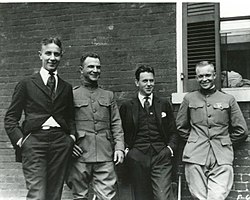
Eisenhower (far right) with three unidentified men in 1919, four years after graduating from West Point.
After the war, Eisenhower reverted to his regular rank of
captain and a few days later was promoted to
major, a rank he held for 16 years.
[13] The major was assigned in 1919 to a transcontinental Army convoy to test vehicles and dramatize the need for improved roads in the nation. Indeed, the convoy averaged only 5 mph from Washington, D.C., to San Francisco; later the improvement of highways became a signature issue for Eisenhower as President.
[56]
He assumed duties again at
Camp Meade,
Maryland, commanding a battalion of tanks, where he remained until 1922. His schooling continued, focused on the nature of the next war and the role of the tank in it. His new expertise in
tank warfare was strengthened by a close collaboration with
George S. Patton,
Sereno E. Brett, and other senior tank leaders. Their leading-edge ideas of speed-oriented offensive tank warfare were strongly discouraged by superiors, who considered the new approach too radical and preferred to continue using tanks in a strictly supportive role for the infantry. Eisenhower was even threatened with court martial for continued publication of these proposed methods of tank deployment, and he relented.
[57][58]
From 1920, Eisenhower served under a succession of talented generals –
Fox Conner,
John J. Pershing,
Douglas MacArthur and
George Marshall. He first became executive officer to General Conner in the
Panama Canal Zone, where, joined by Mamie, he served until 1924. Under Conner's tutelage, he studied military history and theory (including
Carl von Clausewitz's
On War), and later cited Conner's enormous influence on his military thinking, saying in 1962 that "Fox Conner was the ablest man I ever knew." Conner's comment on Eisenhower was, "[He] is one of the most capable, efficient and loyal officers I have ever met."
[59] On Conner's recommendation, in 1925–26 he attended the
Command and General Staff College at
Fort Leavenworth, Kansas, where he graduated first in a class of 245 officers.
[60][61] He then served as a
battalion commander at
Fort Benning,
Georgia, until 1927.
During the late 1920s and early 1930s, Eisenhower's career in the post-war army stalled somewhat, as military priorities diminished; many of his friends resigned for high-paying business jobs. He was assigned to the
American Battle Monuments Commission directed by General Pershing, and with the help of his brother
Milton Eisenhower, then a journalist at the Agriculture Department, he produced a guide to American battlefields in Europe.
[62] He then was assigned to the
Army War College and graduated in 1928. After a one-year assignment in France, Eisenhower served as executive officer to General George V. Mosely, Assistant Secretary of War, from 1929 to February 1933.
[63] Major Dwight D. Eisenhower graduated from the
Army Industrial College (Washington, DC) in 1933 and later served on the faculty (it was later expanded to become the Industrial College of the Armed Services and is now known as the
Dwight D. Eisenhower School for National Security and Resource Strategy).
[64][65]
His primary duty was planning for the next war, which proved most difficult in the midst of the
Great Depression.
[66] He then was posted as chief military aide to General MacArthur, Army
Chief of Staff. In 1932, he participated in the clearing of the
Bonus March encampment in Washington, D.C. Although he was against the actions taken against the veterans and strongly advised MacArthur against taking a public role in it, he later wrote the Army's official incident report, endorsing MacArthur's conduct.
[67][68]
Ike
From Wikipedia, the free encyclopedia
Ike may refer to:
Weather[edit]
- Ike (given name), a list of people (and fictional characters) with the nickname or given name
- Ike no Taiga (1723–1776), Japanese painter and calligrapher
- Chika Ike (born 1985), Nigerian actress, entrepreneur and philanthropist
- Ike Gyokuran (1727–1784), Japanese painter, calligrapher and poet
- Reiko Ike (born 1953), Japanese retired actress, singer and entertainer
- Dwight D. Eisenhower (1890–1969), American General and President, famously nicknamed "Ike", as in "I like Ike".
Other uses[edit]
- Ike (miniseries), 1979 television miniseries about Dwight D. Eisenhower
- Ike: Countdown to D-Day, a 2004 American television film
- Interstate 290 (Illinois), a portion of which is officially named the Dwight D. Eisenhower Expressway, or the "Ike"
- USS Dwight D. Eisenhower, a Nimitz-class supercarrier, also known as the "Ike"
- Ike, Texas, United States, an unincorporated community
- ike, ISO 639-3 code for Inuktitut, an Inuit language of Canada


